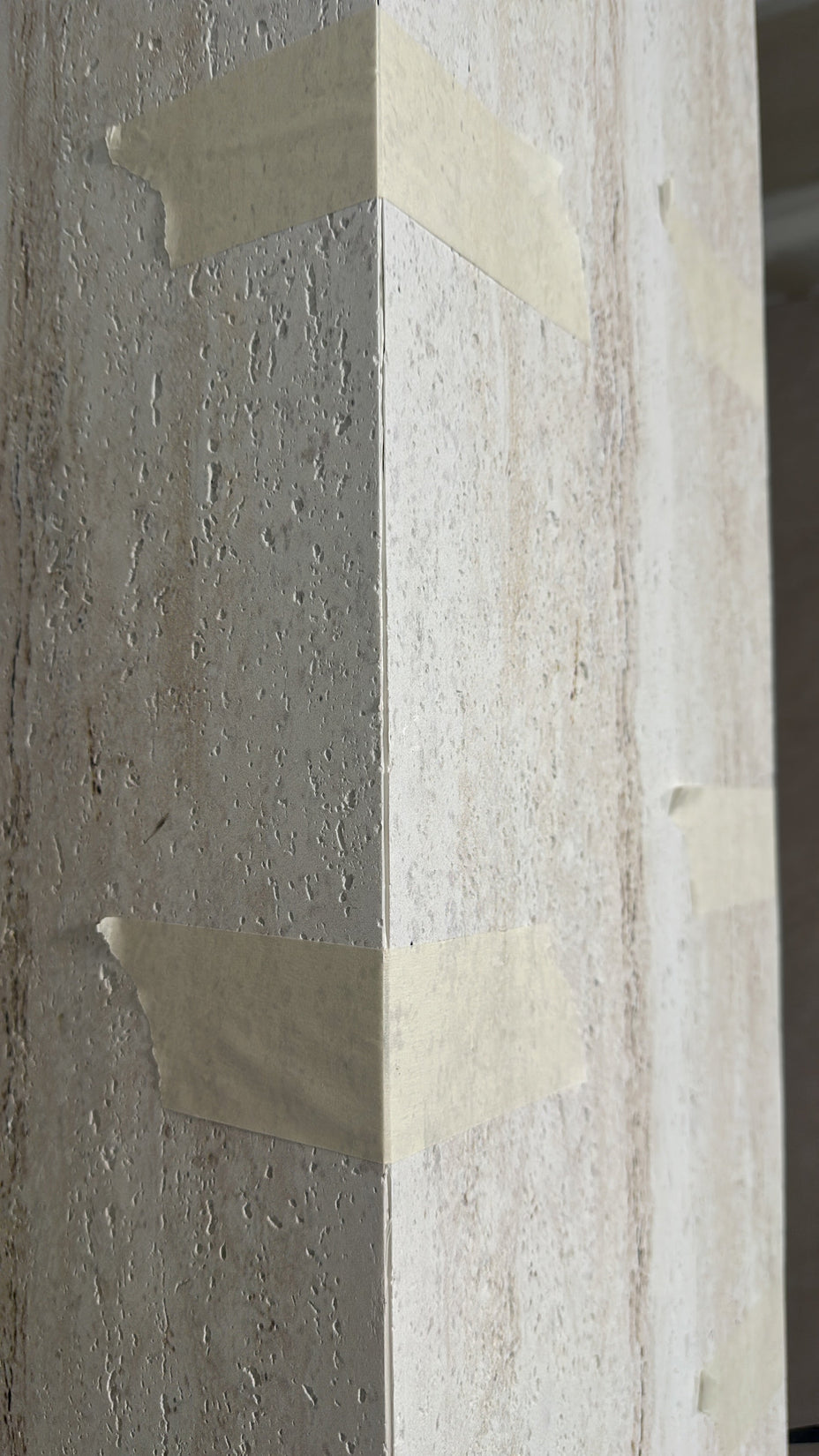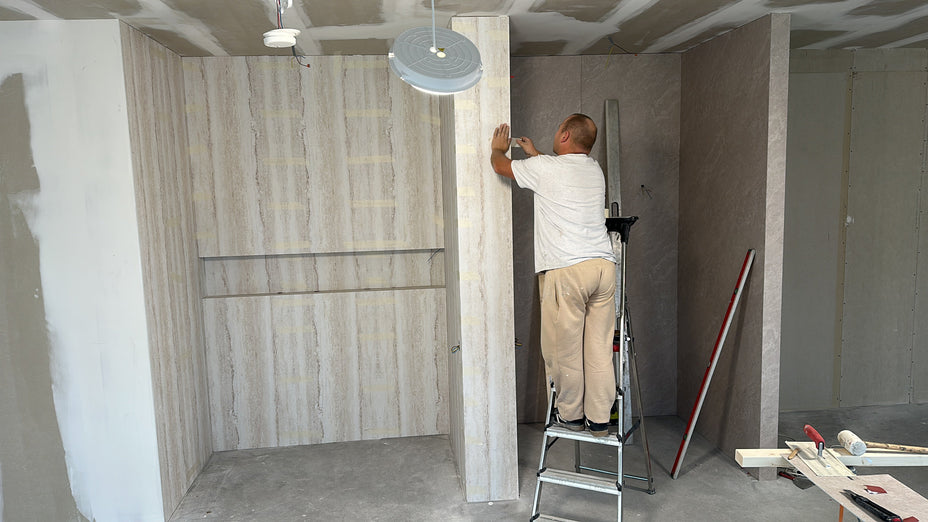


A bathroom renovation without tiling — or rather, without taking the old tiles off — is what many people look for when the tiles are still sound but the room feels dated. You leave the existing wall tiles in place and clad them, in practice with large-format PVC wall panels of 280×122 cm, bonded over the old wall. This article is about what actually changes, when the approach fits, and when you are better off removing the tiles. How PVC panels behave in a bathroom and in the shower is covered in PVC wall panels in the shower: what actually matters.
What “without tiling” means here
You are not skipping a renovation. You are skipping the demolition, as long as the existing tiles are sound, flat, dry, clean and degreased. The walls get a new finish; the rest of the bathroom — pipework, mixer, floor, layout — stays as it is, or you change it separately if you want to. “Without tiling” here means without hacking the wall tiles off. It is not a promise that every bathroom qualifies, and it is not a whole remodel in one sentence.
The practical sequence, including how a day on site can look, is in how to renovate a bathroom without removing tiles. Below, the question is the decision: what you gain, what stays the same, and where the line is.
When the old tiles can stay
You glue PVC and SPC panels straight over old tiles, with a polymer adhesive, if the substrate cooperates. Sound means no hollow or loose tiles. Flat means no large bulges or gaps that a 3 mm board will not hide — that board follows the shape of the wall. Dry, clean and degreased: adhesive will not bond to soap residue or moisture.
If those conditions are met, demolition is usually unnecessary. No clouds of dust, no skip for rubble, no weeks of bare walls. That is exactly why people choose this route. Loose or hollow tiles are dealt with first; only then do you glue. How you glue is in the step-by-step guide to installing wall panels. The 600 ml polymer adhesive costs €9.90 a cartridge. How many you need depends on the substrate; we ask that when we quote, rather than inventing a rule of thumb.
When you are better off removing the tiles
Not every wall is a candidate. If tiles are loose over large areas and you cannot repair them reliably, gluing over them makes little sense. The same applies to a wall that is badly bowed or hollow: the PVC board is 3 mm thick and takes on that shape. And if you want to change the whole layout — move the shower, take out a wall, reroute pipes — you will be doing work in which the old tiles are in the way anyway.
The intended use matters too. PVC and SPC wall panels are not meant for outdoors and not for rooms above 60 °C. If, in a few years, you want to be able to replace the finish tile by tile, remember that glued panels are harder to take off. Tiles then remain an option. We also wrote about that choice in wall panels instead of tiles.
What changes — and what does not
What does change is the wall. You get a new décor, few seams, and no metres of grout to scrub out. Finishing the walls is quicker than a full tiling job, and the material price is predictable: PVC panels start at €49 a board (around €14 per m²). Delivery is always €49. What a complete wall costs, we work through in What PVC wall panels cost per m².
What does not change by itself: the ventilation. Fewer grout lines mean fewer places for mould to take hold, but a panel does not make mould impossible. Mould comes from moisture and stale air; you still need to air the room. Whether the bathroom is watertight depends on the finish: seams, corners and the junction at the shower tray or bath are sealed with sanitary silicone. The floor, the mixer and the pipework stay as they are, unless you deliberately include them in the job.
The wall finish: panels instead of new tiles
At Dizzplace the main option is PVC boards of 280×122 cm (3.416 m²): a straight wall up to 2.80 m high and about 1.22 m wide, covered with one board. In the bathroom wall panel collection those boards sit next to SPC sets of three planks (60×280 cm, together 180×280 cm, 4 mm thick) and flexible Elastone panels of 60×280 cm. PVC is bonded over the full face, including over tiles. SPC has a click system; you first click the three planks into one 180×280 cm sheet, then glue that sheet. The comparison is in PVC or SPC wall panels?
For curves and columns there is Elastone: flexible panels of mineral mortar with elastomer, 60×280 cm, 3 to 8 mm, €79 each, also bonded onto old tiles, for indoor and outdoor use. We do not automatically claim the same shower use as for the PVC boards; ask us if you want Elastone in a wet zone.
The material itself, the shower and day-to-day care are covered in PVC wall panels in the shower: what actually matters. This piece stays with the renovation decision.
The shower: where you notice the difference most
A tiled shower face has metres of grout; one 280×122 cm panel has none. That is most noticeable in the shower: fewer grout lines to clean, and a surface that does not take up moisture. The material is 100% waterproof. The enclosure becomes watertight only at the sealed edges — corners, the seam between boards, the meeting with the tray and the mixer cut-out. A careless seal will let water through, even behind a waterproof board.
After sealing, wait before you shower: silicone usually needs a day, and the adhesive cures more slowly. The fitting guide says: wait at least a day after sealing, and longer if the adhesive layer is thicker. Layout and the junction with the tray are in shower wall panels.
Samples, a quote, and viewing in Valkenswaard
Colour on a screen is not colour in your bathroom light. Order 20×20 cm samples first, through the sample set: 1 sample €9.50, 5 samples €20, with free shipping. Hold them in the shower next to the mixer and the floor, in daylight. Only then the full boards.
We deliver ourselves in the Netherlands (within 200 km of the warehouse in Valkenswaard), in Belgium (within 100 km of the warehouse in Schelle) and in Germany (within 100 km of the warehouse in Dortmund). Delivery always costs €49, regardless of distance and order size. Adhesive is only sent together with panels. Outside that zone you can collect in Valkenswaard. For a larger project, send your wall measurements through the quote page — we reply within 48 hours. We do not put a flat fitting-service price here: that depends on the job and belongs in the quote.
Prefer to see them first? At Valkenswaard, John F. Kennedylaan 40, you can view the panels by appointment. There are no fixed opening hours; we arrange a time via the contact page or WhatsApp.
Frequently asked questions
Can I renovate my bathroom without removing the tiles?
Yes, if the wall tiles are sound, flat, dry, clean and degreased. You glue panels over them. Fix loose tiles first. If the approach does not fit — for example if you are changing the whole layout — demolition is still the more logical path.
Does the floor have to stay as well?
Not necessarily. The wall approach leaves the floor alone, but you can deal with the floor separately. This article is about the walls, not about a whole bathroom in one move.
Are the walls watertight afterwards?
The panel material is 100% waterproof and does not take up moisture. Whether the bathroom is watertight depends on the finish: seams, corners and the edge at the shower tray or bath are sealed with sanitary silicone. Wait at least a day after sealing before you shower.
What if a tile is loose?
Then you do not simply glue over it. Repair it first, then fit the panel. A 3 mm board follows the substrate; a hollow tile remains a weak point.
What does this approach cost?
PVC panels start at €49 a board (around €14 per m²). Delivery is €49, the adhesive €9.90 per 600 ml cartridge. We do not state a flat fitting price; that belongs in a project quote with your measurements. The worked examples are in What PVC wall panels cost per m².
Can I order a sample first?
Yes. 20×20 cm samples through the sample collection: 1 sample €9.50, 5 samples €20, free shipping.
A sensible order: samples first, then the decision to leave the tiles, then the panels in the bathroom collection — or a quote with your wall measurements. For the material, the shower and maintenance, continue with PVC wall panels in the shower: what actually matters. An honest account of a renovation we carried out ourselves is in bathroom wall panels.