

Flexible mineral wall panels are thin, bendable sheets with the look of stone and travertine. At Dizzplace this line is called Elastone: format 60×280 cm, €79 per panel. This guide explains what they are, how they are made, which series exist, what they cost, how you glue them, and where the limits are — including how they differ from PVC and SPC. Renovation use — arches, columns and bonding over existing tiles — is in Stone-look wall panels without heavy stone. More on the travertine look itself is in Flexible travertine wall panels: the Elastone collection. PVC and SPC prices are in How much do PVC wall panels cost per m²?.
What are flexible mineral wall panels?
Elastone is Dizzplace’s line of flexible mineral wall panels, in the shop since 24 October 2026. The name joins elastic and stone. The flexible stone wall panel collection has 12 designs. Each full panel measures 60×280 cm, or 1.68 m²: one piece covers a wall up to 280 cm high, with no horizontal joints.
According to the product pages, the panel is made from finely ground minerals — clay, quartz sand and stone meal — bound with a flexible polymer binder. The mass is pressed in a mould that reproduces a stone texture and is cured without firing. It is not a slab cut from solid stone, not PVC and not SPC. The material description on the Dizzplace blog also mentions a reinforcing mesh. The supplier’s exact recipe and a fire classification are not documented in the shop, so we do not quote those figures here.
That is a different product from the PVC wall panels of 280×122 cm, which you glue as a rigid sheet, and from the SPC sets with a click system. Elastone has no click joint. Its advantage is bending around arches and a texture you can feel, at a modest thickness.
Look and three series
All panels have a matt surface you can feel under your fingers. The collection has three series:
- Elastone Travertine — 8 travertine shades, 3 mm thick, TF1 to TF8, with pores and veins. TF1 is white travertine with thin, horizontal beige veins; TF4 is warm beige with rust-coloured veins.
- Temple Line, in the Vintage Stone series — White and Off-white, 5 mm, fine parallel or brushed lines.
- Ancient Stone, also Vintage Stone — White and Off-white, 8 mm, deep ribs and a grainy stone texture. Ancient Stone White is snow-white, with dense vertical ribs.


Cutting depends on thickness. According to the product pages: 3 mm is cut with a sharp knife or shears; 5 mm and 8 mm with a saw or a grinder with a diamond disc. Colour on a screen can differ from the real panel, so order a sample first.
Prices and figures from the shop
Each of the 12 panels costs €79. At 1.68 m² that is about €47 per m² (79 ÷ 1.68 ≈ 47.02). That is a sum from price and size, not a separate “from” price on the collection. The polymer mounting adhesive, 600 ml costs €9.90. A 20×20 cm sample costs €5, for example the TF1 sample.
For comparison, from the November 2026 price article: PVC sheets 280×122 cm start at €49, about €14 per m²; an SPC click set (3×60×280 cm) costs €179, about €35.52 per m². The mineral panels therefore cost more per square metre than typical PVC. The price on the product page applies.
The weights in the shop are estimates, intended to be corrected later after weighing: about 8 kg at 3 mm, 13 kg at 5 mm and 19 kg at 8 mm. Do not treat them as a laboratory weighing.
Where they work — and where they do not
According to the product pages, the panels suit living rooms, bedrooms, kitchens and hallways, as well as columns, arches and niches. On a fireplace surround, keep a distance from an open flame. The shop allows indoor and outdoor walls, on an even, load-bearing substrate. Outdoor use is not automatic approval of every façade build-up: discuss a specific outdoor project first, because rain, sun and temperature swings demand more than a dry indoor wall.
In a bathroom the product pages allow use outside the zone of a direct water jet. We do not promise shower use here. For wet zones with a direct spray, waterproof PVC sheets are a better fit, as described in PVC wall panels in the shower. The panels are not for floors.
How you fit them
The substrate must be even, load-bearing, clean and dry: plaster, concrete, plasterboard, and also old tiles. A flexible panel will follow unevenness, so the wall really has to be flat. Spread polymer adhesive over the full surface with a 3–4 mm notched trowel. Do not spot-glue — the panel will ripple. According to the product pages, about one 600 ml cartridge is enough for one panel.

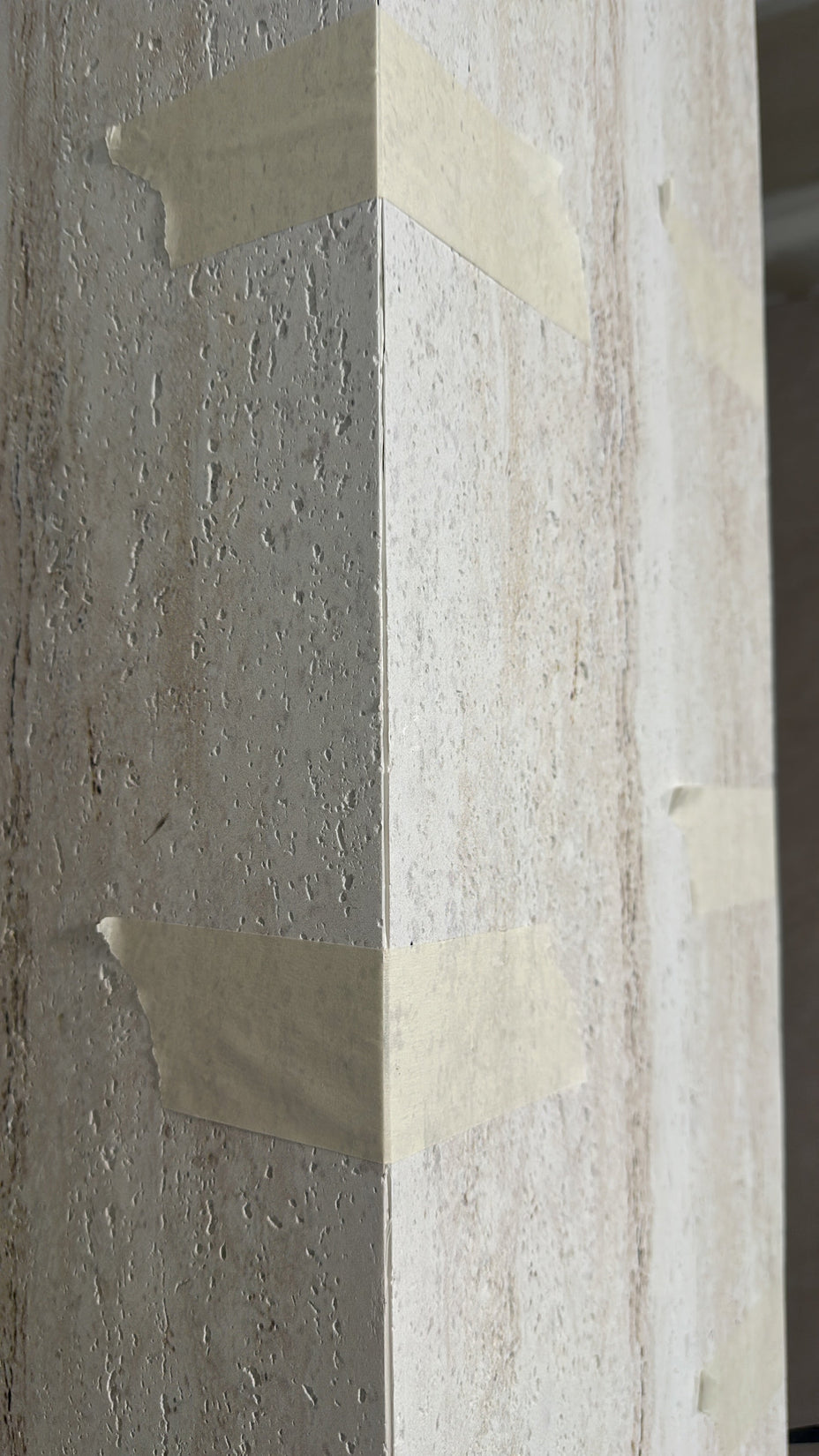
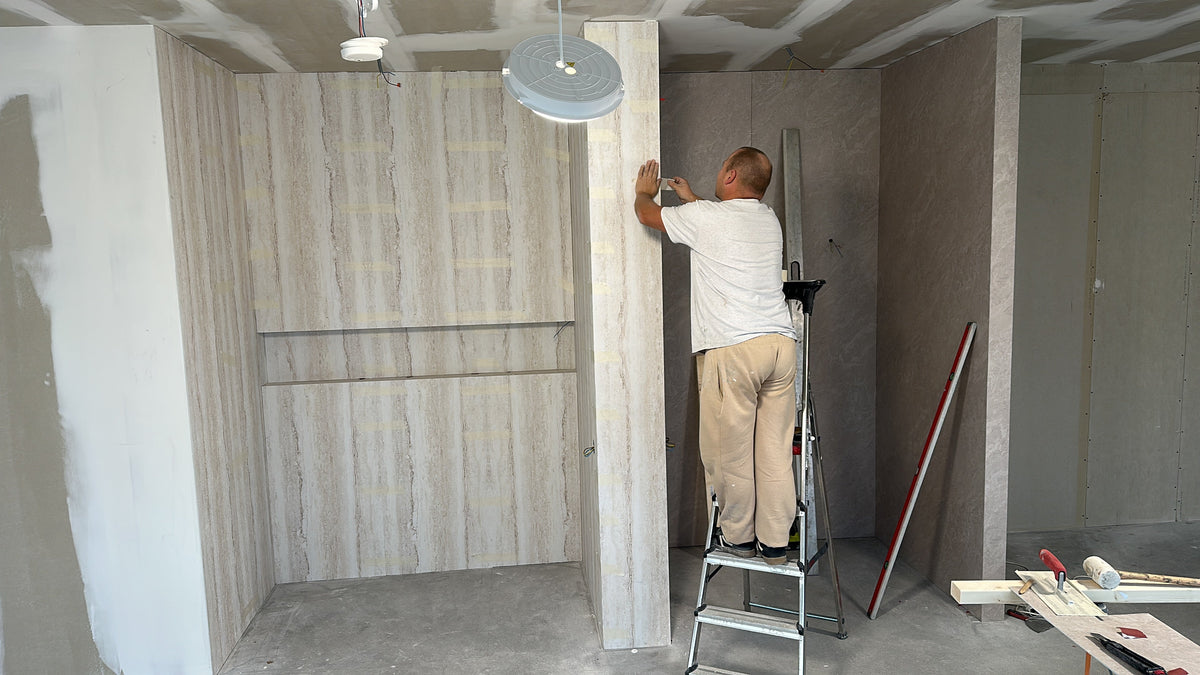
Leave the panels in the room for 24 hours before fitting. Work at about +10…+25 °C. At the 280 cm format the shop recommends two people: support the panel at the bottom and press from the centre outwards. Around arches, bend slowly and support the panel until the adhesive sets. According to the product page, 3 mm Travertine panels suit arches and half-columns with a radius from about 30 cm; that is a shop figure, not an independent measurement. For 5 mm and 8 mm the pages only mention a “larger radius”, with no number — we do not invent one. You cannot wrap a sharp 90° corner with one panel: cut and butt-joint, or finish with a profile. In the Dizzplace showroom you can see such a joint, temporarily held with tape.
One panel covers 60 cm of wall width up to 280 cm in height. Divide the wall width by 0.6 m and add spare: 5–10% on straight walls, 10–15% on curves. You can send measurements via the project quote page — we reply within 48 hours. We do not quote a fixed hourly rate for installation by us here. General glue-down rules are also in the step-by-step installation guide; this article stays with Elastone.
Care, samples and delivery
Clean with warm water and a soft cloth. Do not use solvents, acetone, acids, descalers or abrasive cleaners.
20×20 cm samples cost €5 each and show the colour in your light. They are in the sample collection. We deliver ourselves in the Netherlands (within 200 km of Valkenswaard), Belgium (within 100 km of Schelle) and Germany (within 100 km of Dortmund). Delivery is always €49. Adhesive travels only together with panels. Outside the zone you can collect in Valkenswaard, John F. Kennedylaan 40, and view the panels by appointment — no fixed opening hours, via the contact page.
Frequently asked questions
Is this real travertine or natural stone?
No. These are mineral panels with the look and feel of stone. They are not slabs cut from a solid block.
How do they differ from PVC and SPC?
PVC 280×122 cm is glued as a rigid sheet; SPC has a click system in a three-board set. The mineral panels are bendable, have no click joint, and cost more per m² than typical PVC.
Can I use them in a shower?
The product pages allow bathroom use outside the zone of a direct water jet. We do not promise shower use here.
Can I glue them over old tiles?
Yes, if the tiles are stable, even, clean and dry. Full-surface adhesive, 3–4 mm notched trowel.
Does every design bend the same way?
No. The series are 3, 5 and 8 mm. For 3 mm the product page gives a radius from about 30 cm. For 5 and 8 mm there is no number, only a larger radius.
Can they go on the floor?
No. The product description excludes floors.
Can I order a sample first?
Yes, 20×20 cm for €5, then a full panel from the Elastone collection.