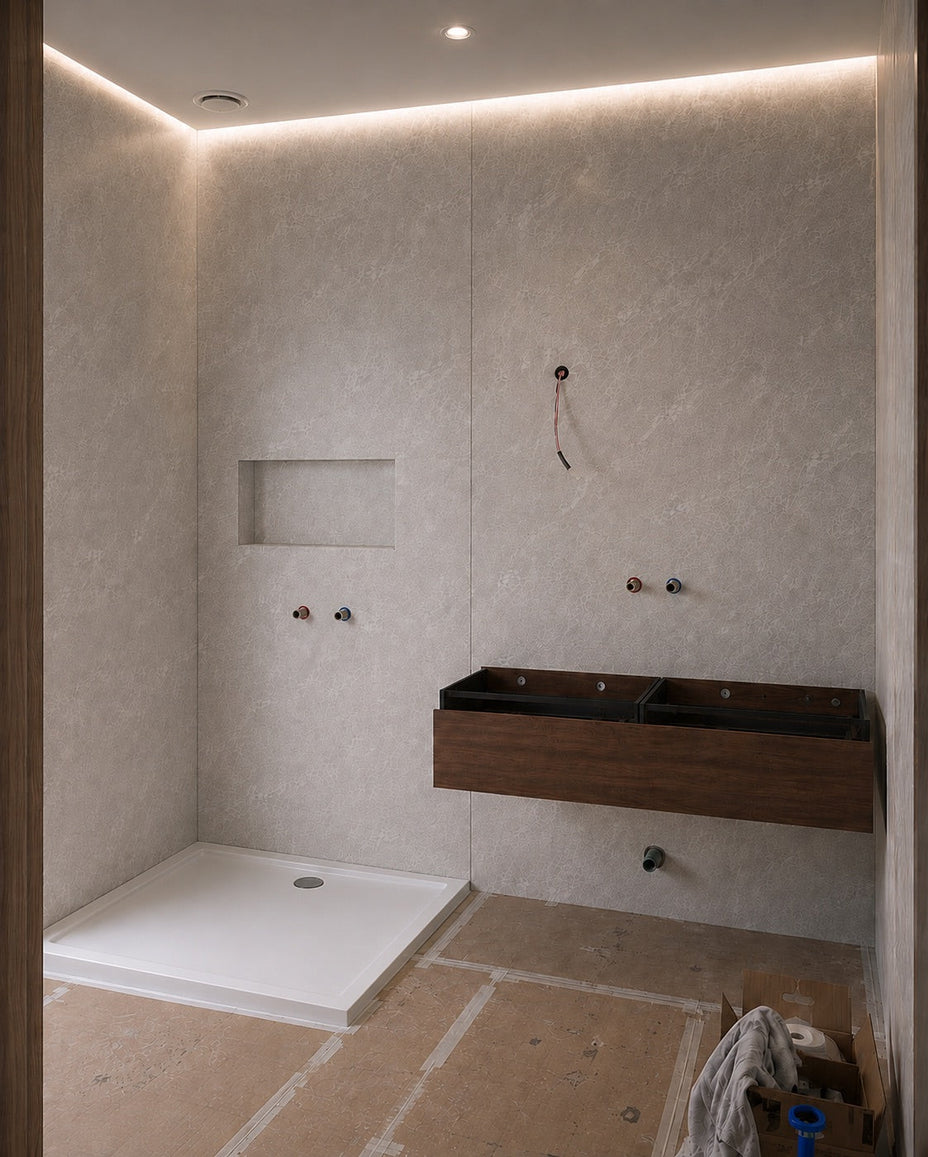
Shower wall panels are large, waterproof boards that you use to line the walls of your shower instead of tiles: no grout lines, often one board per wall. You glue a 280 × 122 cm PVC wall panel over the old tiles, and whether the shower stays watertight comes down to three places: the edge of the shower tray, the corners and the openings for the mixer. A board costs from €49.
A note on names: in many shops a "shower panel" is a column with a rain shower and massage jets. This is about something else, the shower wall itself.
Before and after: a corner shower with Sahara Sand wall panels

Before: beige tiles with a border strip and grout on every wall, including inside the shower.
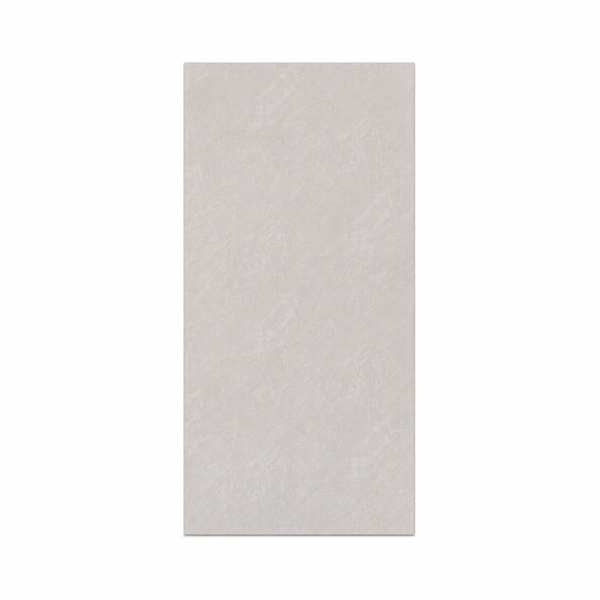
A bathroom with a quadrant corner shower, the kind you find in a great many homes. The beige tiles with their border strip were replaced by the Sahara Sand wall panel, a warm beige with diagonal veining, on every wall, including the two walls inside the shower. The shower enclosure and tray stayed the same. You can see the result in the photo at the top: there is not a single grout line left to scrub in the shower.
How many wall panels do you need for a shower?
A PVC panel is 122 cm wide and 280 cm tall, so in most bathrooms one board covers a shower wall from tray to ceiling.
- 90 × 90 cm corner shower: two walls, so two boards.
- 120 × 90 cm shower: also two boards, one per wall.
- Walk-in shower against one wall up to 122 cm: one board.
- Wall wider than 122 cm: two boards with a joint. With PVC you seal the joint with sealant; with SPC sets the click joint closes it without a seam.
How do you finish the panel at the shower tray or bath?

The panel stops above the rim of the tray and the gap is sealed with silicone. You can also see the narrow joint between the boards in the corner and the mixer mounted on the panel.
The panel stops above the rim of the shower tray or bath, not behind it and not on top of it. Leave a gap of a few millimetres and fill it with mould-resistant sanitary sealant. This is the spot in the bathroom that takes the most water, so do it carefully: mask both sides, apply the sealant, smooth it and remove the tape straight away.
Openings for the mixer and pipes
Cut the holes from the decor side, only slightly larger than the pipe. Fill the gap around the pipe with sealant, and the mixer's cover plate hides the edge.
If you are gluing the panels over tiles, sealant is all you need, because there is already a watertight layer underneath. If the wall is new, read the section on the substrate below.
What substrate can you glue shower wall panels to?
Over existing tiles you glue directly. The tiles act as the waterproof barrier and the sealant closes the joints. The condition: the tiles are firmly attached and thoroughly degreased.
On new plasterboard or freshly plastered walls the shower zone needs waterproofing, just as it would under tiles. The standard build-up is moisture-resistant (green) plasterboard, a primer, two coats of liquid waterproofing membrane, and sealing tape in the corners with collars around the pipes. Only then do you glue the panel. Check the membrane's data sheet to confirm the manufacturer allows polymer adhesive on top.
Always spread the adhesive over the entire back of the panel with a notched trowel. The whole process is in our step-by-step guide to installing wall panels.
What is the ideal thickness for a shower wall?
A PVC panel is 3 mm and SPC 4 mm, and both are 100% waterproof. In the shower, thickness matters less than how the panel is glued and what it is glued to. A board bonded over its full surface to a flat, watertight wall will perform whether it is 3 or 4 mm thick. SPC is stiffer and hides small irregularities better.
Limescale and cleaning
Clean the panels with a cloth or sponge and an ordinary bathroom cleaner. Descalers are fine too. Just avoid wire wool and gritty abrasive creams, which scratch the surface. The least work of all is a squeegee after every shower: with no grout, the water comes off the whole wall in one pass.
What does a shower wall made of panels cost?
A 90 × 90 cm corner shower takes two PVC boards, from €98, plus adhesive and sealant. No tiler, no demolition and no week without a bathroom. Would you rather have it fitted for you? We do that too: ask when you order.
See the design in real life
A colour looks different under your bathroom lighting than on a screen. Order up to five 20 × 20 cm samples at €5 each, shipped free, or come and see the boards in Valkenswaard, Schelle or Dortmund, by appointment. Marble-look designs are in the marble-effect wall panels collection.
Send us a photo and the measurements of your shower on WhatsApp: +31 6 8551 3217 and we'll work out how many boards you need. Delivery time is 1 to 3 working days.