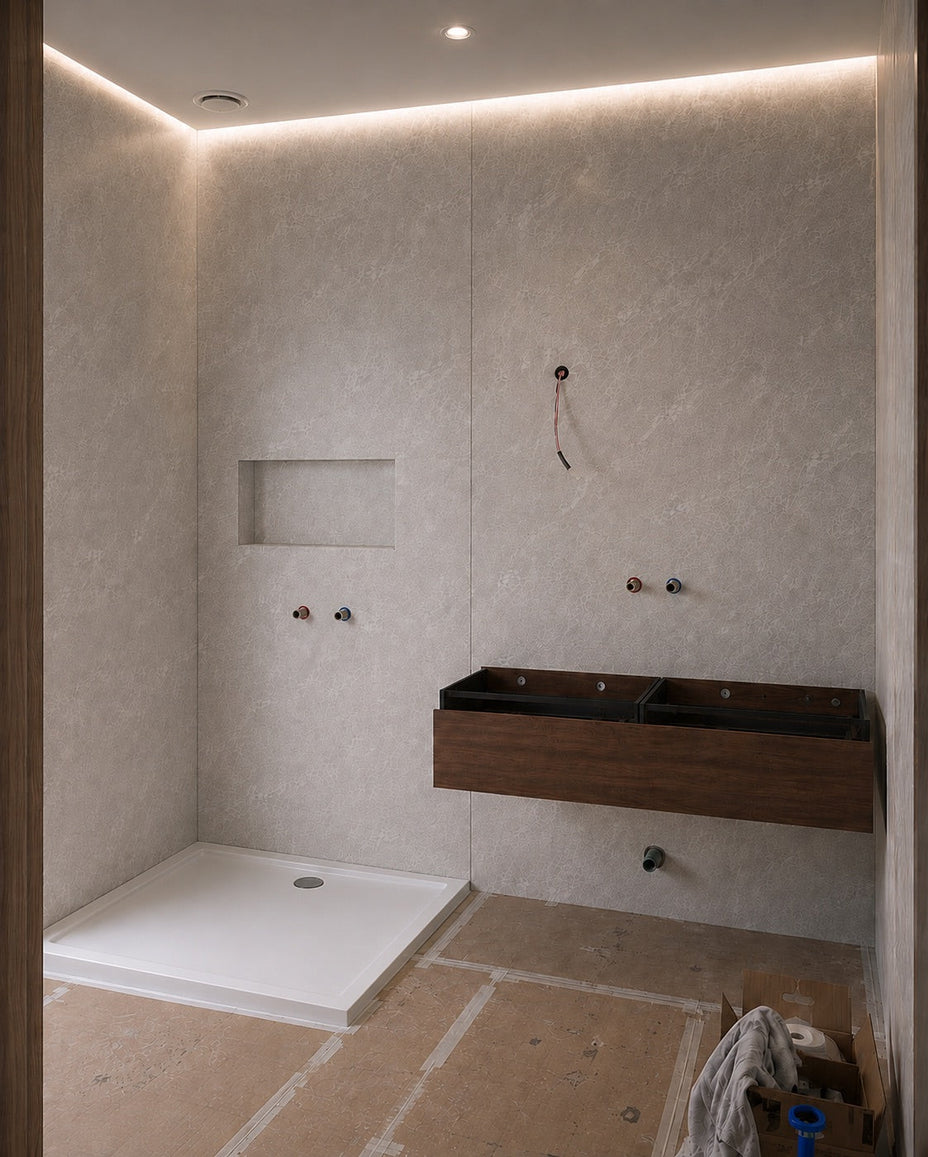
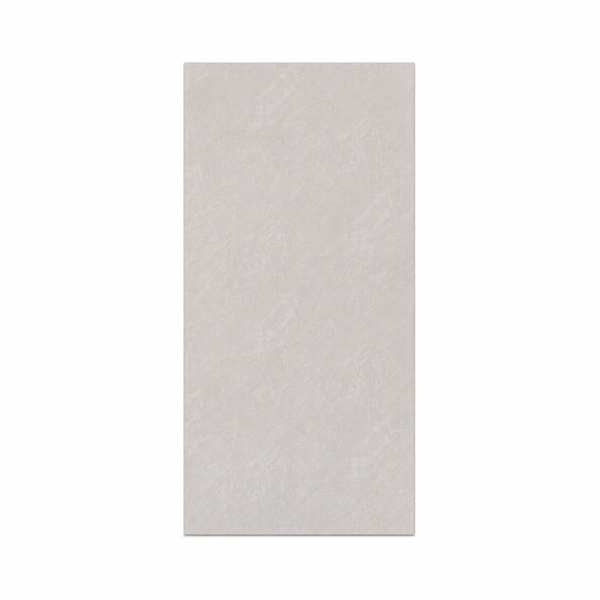
A PVC wall panel is one of the simplest ways to get a new kitchen splashback: you glue it over the old tiles, with no demolition and no grout lines. It works behind induction and ceramic hobs, doesn't absorb grease and cleans with ordinary washing-up liquid. One 280 × 122 cm board costs from €49.
Below is a kitchen where we recently fitted a wall panel between the cabinets ourselves, with before and after photos, followed by answers to the questions we hear most often.
Before and after: the tiles stayed, the grout lines went

Before: white tiles with grey grout, as in many kitchens.
The starting point was the same as in many homes: white tiles with a faint marble pattern, grey grout and two sockets above the worktop. Nothing broken, but the wall was showing its age, and the grout by the sink and hob is always the first thing that needs scrubbing.
We didn't remove the tiles. We glued the Patagonia Quartzite wall panel straight onto them, in the strip between worktop and wall cabinets, with cut-outs for the sockets. We spread the adhesive over the entire back of the board with a notched trowel, as we always do. You can see the result in the photo at the top: one calm surface with a natural stone pattern instead of a grid of grout lines.
Can a wall panel go behind the hob?
Yes. PVC and SPC wall panels work well behind induction and ceramic hobs. Keep the distance from the hob that is normal in a kitchen between hob and splashback; nothing more is needed.
Behind a gas hob it works too, with one condition: the panel must be at least 30 cm from the open flame, because a flame produces a much higher temperature than induction. A wall panel is also no place for hot pans: don't lean a pan against it straight off the heat.
Behind the hob, what matters most is how the panel is glued. It has to be bonded to the wall over its entire surface. If the adhesive sits in a few widely spaced blobs, voids are left behind the panel, and the high temperature can then make it deform over time. That's why we always spread the adhesive over the entire back of the board with a notched trowel.
Does a wall panel absorb grease, and how do you clean it?
No. The surface is smooth and closed, so grease and dirt don't stick to it, and there is no more grout to scrub.
For everyday cleaning, a sponge, a cloth and ordinary washing-up liquid are enough. A kitchen degreaser is fine too. We don't recommend caustic products, as they can fade the surface over time, nor abrasive creams or wire wool, which scratch it.
PVC or SPC in the kitchen?
Both materials have the same protective top layer, so in normal use they are equally resistant to grease, water and cleaning. SPC is stiffer and handles mechanical damage better, such as a knock from the edge of a pan.
| PVC panel | SPC panel | |
|---|---|---|
| Format | 280 × 122 cm | 60 × 280 cm, set of 3 |
| Thickness | 3 mm | 4 mm |
| Installation | gluing | gluing + click joint |
| Impact resistance | good | higher |
| Price | from €49 per panel | from €179 per set |
For an ordinary strip above the worktop, PVC is more than enough and cheaper. SPC makes sense if you want a continuous marble pattern across a tall wall, or if your kitchen gets heavier use.
How many wall panels do you need for a kitchen splashback?
Usually fewer than you'd think. In most kitchens the strip between worktop and wall cabinets is about 50 to 65 cm high. From one 280 × 122 cm board you can cut two lengthwise strips of about 60 cm, each 2.80 m long.
So one board covers up to about 5.6 running metres of splashback. If you want a continuous pattern, bear in mind that two strips from one board are two different parts of the stone pattern. In an L-shaped kitchen or on a wall longer than 2.80 m, plan where the joint will fall.
How do you fit a wall panel over kitchen tiles?
Just like in the bathroom, with one difference: kitchen tiles need extra-thorough degreasing, because cooking grease weakens the adhesive bond more than anything else.
- Clean and degrease the tiles and check that none are loose.
- Measure the strip in several places and cut the panel from the decor side, most easily with a utility knife along a straight edge.
- Make cut-outs for the sockets. Switch off the power first, and fix the cover plate afterwards with longer screws.
- Spread polymer adhesive with a 3–4 mm notched trowel over the entire back of the panel, not in blobs or beads, and press it firmly against the wall. We always recommend full-surface gluing: no air is left under the board, so the panel doesn't come away or sound hollow.
- Seal the joint with the worktop and cabinets with sealant.
Every step is covered in detail in our step-by-step guide to installing wall panels.
Which material for your kitchen splashback?
A wall panel is usually compared with new tiles, glass and stainless steel. All four have their place, just not in the same situation.
- New tiles: classic and hard-wearing, but that means knocking off the old ones, a tiler and grout to keep clean again.
- Toughened glass: very sleek and heat-resistant, but made to measure, with cut-outs ordered in advance, and noticeably more expensive.
- Stainless steel: practical behind a cooker, but shows every fingerprint and doesn't suit every home kitchen.
- PVC or SPC wall panel: you fit it yourself over the old tiles, cut it on site with a knife, and get a stone look without grout at a low price. In return, it's not a surface for hot pans.
What does a new kitchen splashback with wall panels cost?
For an ordinary wall above the worktop, one PVC board is enough, from €49, or €69 for premium designs such as Patagonia Quartzite. Add one sausage of adhesive at €9.90 and sealant. No demolition, no rubble and no days without a kitchen.
Would you rather have it fitted for you? We do that too: ask when you order.
See the design in real life
The colour of stone depends on the light in your kitchen, and a screen won't show you that. Order up to five 20 × 20 cm samples at €5 each, shipped free, and hold them against the wall above your worktop. You can also see the boards in Valkenswaard, Schelle or Dortmund, by appointment.
Shall we work out how many panels you need? Send a photo of your wall with the measurements on WhatsApp: +31 6 8551 3217. Delivery time is 1 to 3 working days.